“Good luck, and Godspeed Artemis II, let’s go.” These were the last words spoken to the crew of the Artemis II before they were shot into orbit on April 1, 2026, at 6:35:12 P.M. EDT.
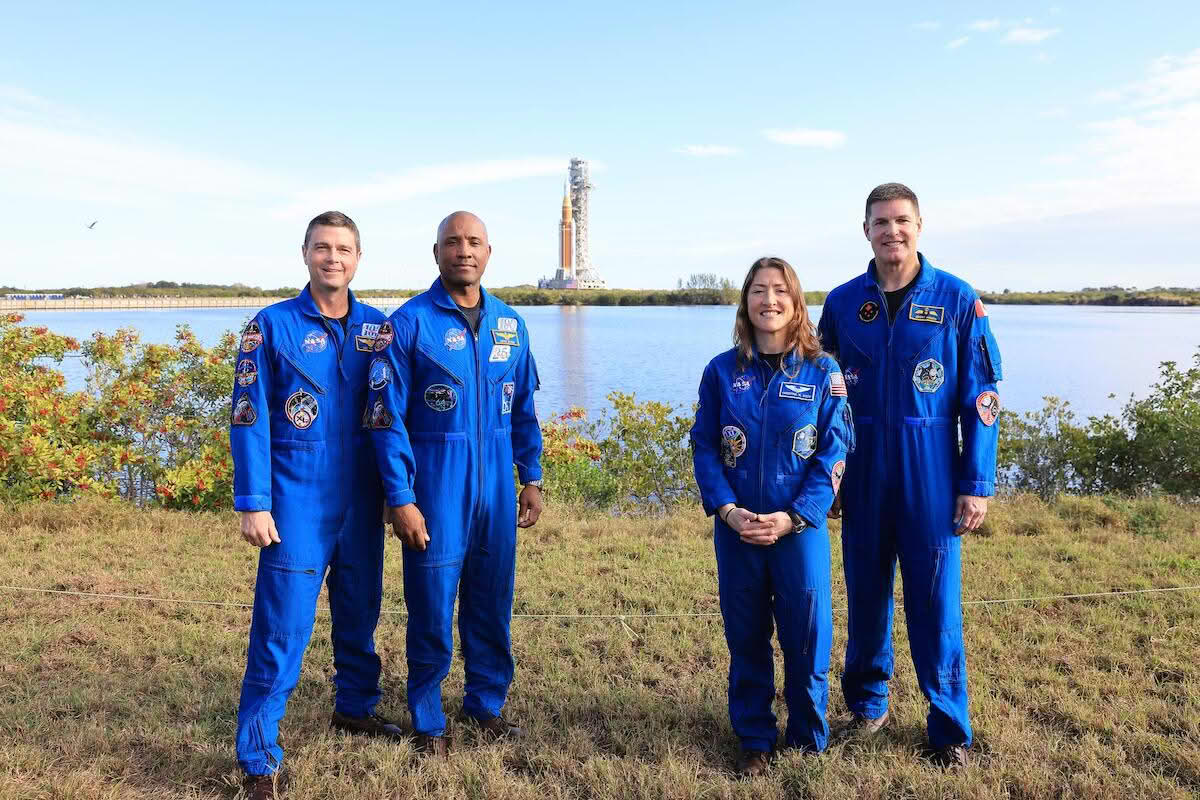
April 1st may have signified a day for you to play tricks on your friends, but to the people at Kennedy Space Center it was a day to go down in history. As four brave astronauts–Reid Wiseman, Victor Glover, Christina Koch, and Jeremy Hansen–went into space to see the far side of the moon for the first time in 50 years.
Unlike the Apollo 13, which was meant to land on the moon but due to an oxygen tank exploding had to turn back, the Artemis II mission was supposed to orbit around the moon. The main goal of this mission was to evaluate the Orion’s systems through planned tests to ensure that all systems would work while deep in space. These included testing the life-support, thermal heating, propulsion, power, and navigation systems. Running these tests helped ensure the habitability, and health of future crews.
This was a crucial mission, so NASA needed to make sure that they had a diverse, well-rounded team that could work well together. Reid Wiseman a 50-year-old father, engineer, and Navy Veteran was a flight engineer at the international space station in 2009. He was a part of expedition 41, a 165-day mission in which there was a 13-hour spacewalk, and over 300 experiments run. Reid earned a Bachelors degree of Science at Rensselaer Polytechnic Institute in Troy and a Masters of Science in Systems Engineering from John Hopkins University in Baltimore. During the Artemis II, he discovered an unnamed lunar crater which he named “Carroll” after his late wife.
Astronaut Victor J. Glover, Jr. was selected in 2013 by NASA, while he was working as a legislative Fellow in the United States Senate. He was also a pilot of the Crew I Dragon Space Craft, Resilience, which flew to the International Space Station. He was born in Pomona, California and currently lives in Berkeley, California with his wife Dionna and their four kids. He received a Bachelor of Science in General Engineering from California Polytechnic State University, a Masters of Science in Flight Test Engineering, and a Master of Military Operational Art and Science.
Christina Koch is an explorer and engineer, and she became an Astronaut in 2013. She lived on the International Space Station for most of 2019 helping with expeditions 59, 60, and 61. She spent a total of 328 Consecutive days in Space. She also walked in the first all-female Space Walk. Before Working for NASA, she worked in a very unique engineering field focusing on the Arctic and Antarctic. She has a variety of hobbies including rock climbing, ice climbing, yoga, surfing, woodworking, photography, backpacking, community service, and travel. She has also won a variety of honors and awards including the Neil Armstrong Award of Excellence from the Astronaut Scholarship Foundation in 2020, Global ATHENA Leadership Award from ATHENA International in 2020, United States Congress Antarctic Service Medal with Winter-Over distinction in 2005, and the NASA Group Achievement Award from NASA Juno Mission Jupiter Energetic Particle Detector Instrument in 2012.
Jeremy Hansen loved flying from a young age, joining the 614 Royal Canadian Air Cadet Squadron in London, Ontario at the age of 12, and gaining his Air Cadet glider pilot wings at 16. Along with learning to fly very young, he is also the first Canadian to go to the moon. Hansen is currently married and has three children. Before this trip he was part of NEEMO 19, a seven-day simulation of deep space exploration on the ocean floor in the Aquarius habitat.
While all of these crew members have been through crazy missions, Victor Glover took a chance to remind everyone how special our everyday life on earth is. “You guys are talking to us because we’re in a space ship really far away from earth, but you’re on a space ship called earth that was created to give us a place to live in the Universe and cosmos,” Glover said. “Maybe the distance we are from you makes you think what we’re doing is special, but we’re the same distance from you. And I’m trying to tell you. Just trust me. You are special. And all of this emptiness, this is a whole bunch of nothing. This thing we call the universe. You have this oasis, this beautiful place so that we get to exist together.”